The neutral read on the counterparties your desk deals with.
Prism scores the institutions your desk deals with (risk, settlement reliability, live compliance) from anonymised signals the whole market contributes. It never trades, quotes, matches, or settles, so it has no side to protect.
The only signal you have on a counterparty is your own history with them.
African FX and treasury markets are priced bilaterally, and there is no shared record. The venues and payment providers that could hold one are principals: they take the other side of your trade, so they cannot credibly rate the names they face.
So you deal on trust. And a name that is quietly deteriorating looks exactly like one that is fine, until it settles late, or doesn't.
A read is only worth trusting if the source has nothing to gain from it.
Prism is neutral by construction. It never trades, quotes, matches, or settles. That's enforced in the code and guarded by tests, not merely asserted. It pools anonymised signals from the desks that actually move the flow, and hands each of them a shared read no single principal could give. The read moves as members submit new signals, and compliance and adverse-media are checked live the moment you look.
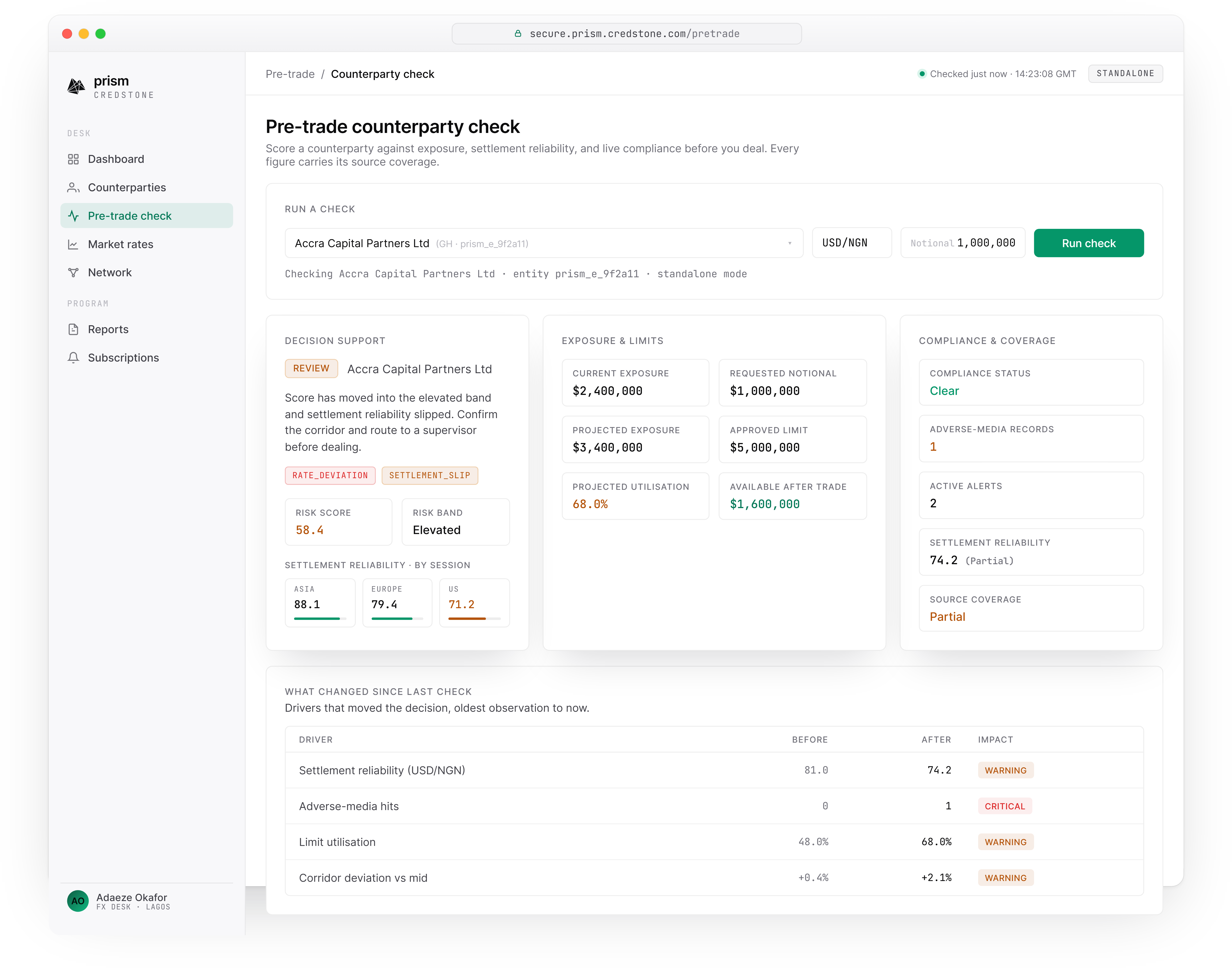
You run an FX book, and you're about to deal USD/NGN with a bank you've traded with for years. Before you confirm, you run one pre-trade check: follow it from the lookup to the hold.
- 01 · Lookup
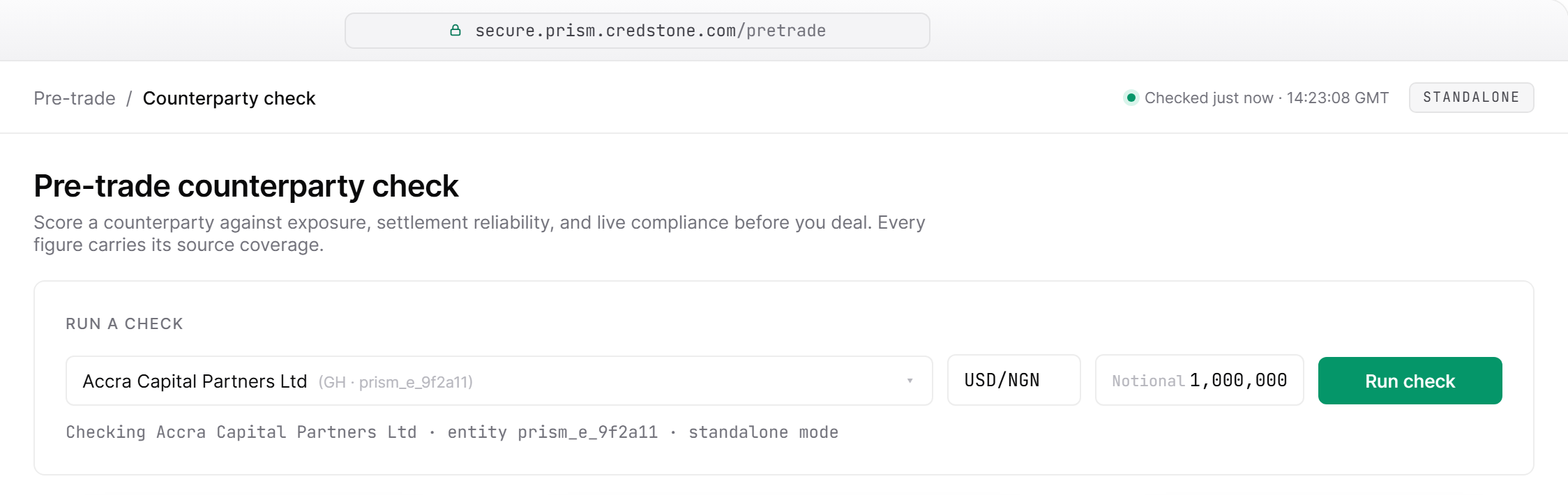
You run the check
One lookup (in Prism's console, or an API call your own systems make before a ticket) pulls the counterparty's record: risk score, settlement reliability, live compliance, recent signals.
- 02 · Decision
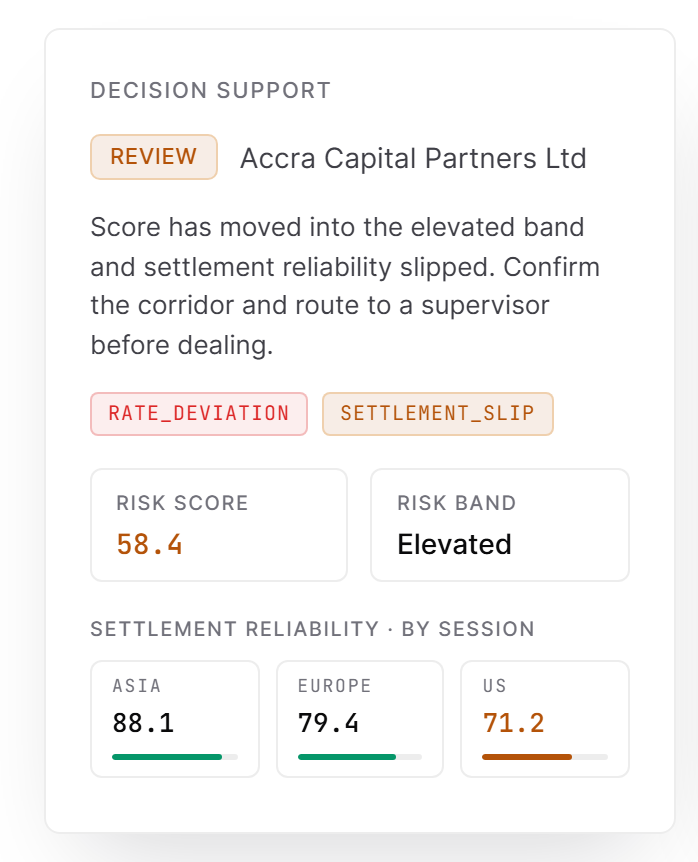
It flags the name for review
The score has climbed into the elevated band since your last deal. You take a second look before you commit.
- 03 · Drivers
It shows you why
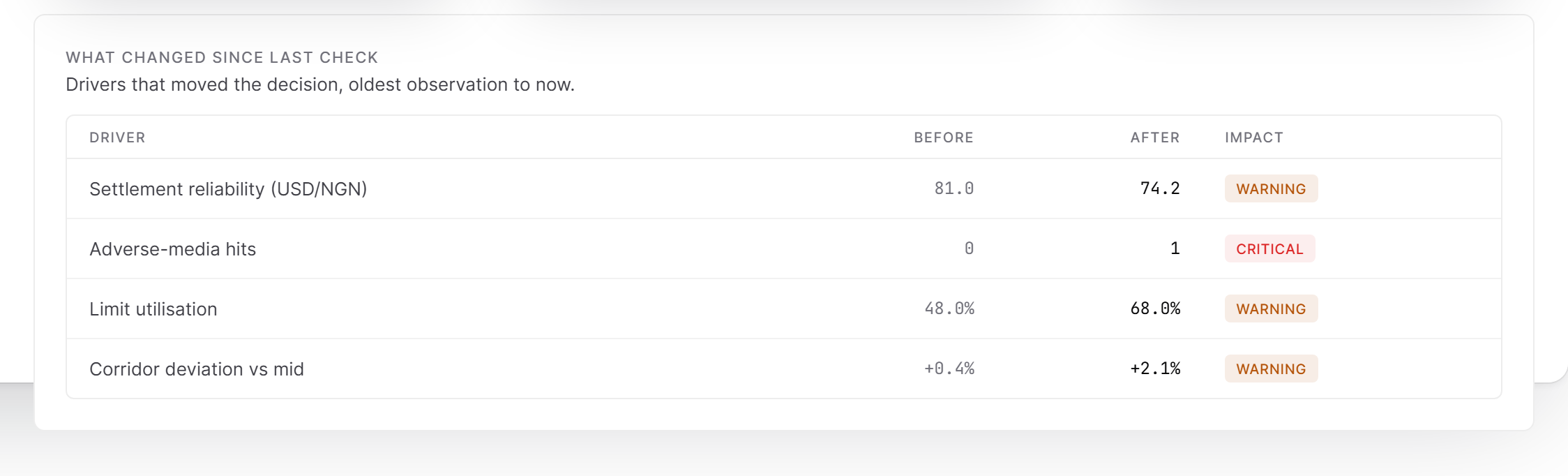
A "what changed" panel names the drivers behind the move: settlement reliability slipped, a screening flag came back on the name, the corridor deviation widened. Each one shows a before and an after.
- 04 · Hold
You hold the deal
The hold lands in the log with a name and a reason: the decision, and why you made it, is on the record.
Every number comes with its coverage: how much real data sits behind it. Where that data is thin, Prism shows a cold-start marker instead of inventing a figure.
You stepped back from a name that looked fine yesterday, before it became a loss.
Same desk, same morning. Every figure you acted on carried its coverage, so the call holds up when someone asks how you made it.
Figures are labelled by how they were established. Targets and illustrative values are not measured production results.
Built for the regulators it ships into
- Foreign Exchange Act 2006 (Act 723)
- The Ghana rule-pack encodes FX Act requirements (AML pass rate, settlement success, enforcement thresholds), and the version is recorded on every score.
- Data Protection Act 2012 (Act 843)
- Hash-only identifiers, k-anonymity on published aggregates, an immutable audit log, and deletion handling for data-subject requests.
- BoG Cybersecurity Directive
- Mutual-TLS partner ingestion, signed webhooks, and an append-only audit log.
How it fits the platform
Resolves every counterparty to one identity. Prism does no matching of its own.
Trains the scoring models offline; Prism only runs them.
Verifies Prism's service and user tokens.
Provisions Prism tenants through the platform.
Prism never trades. That is the whole point.
Deployed to staging and building its founding-partner consortium. Its shared signals are only as strong as the institutions that contribute them.
Book a technical walkthroughOrigin
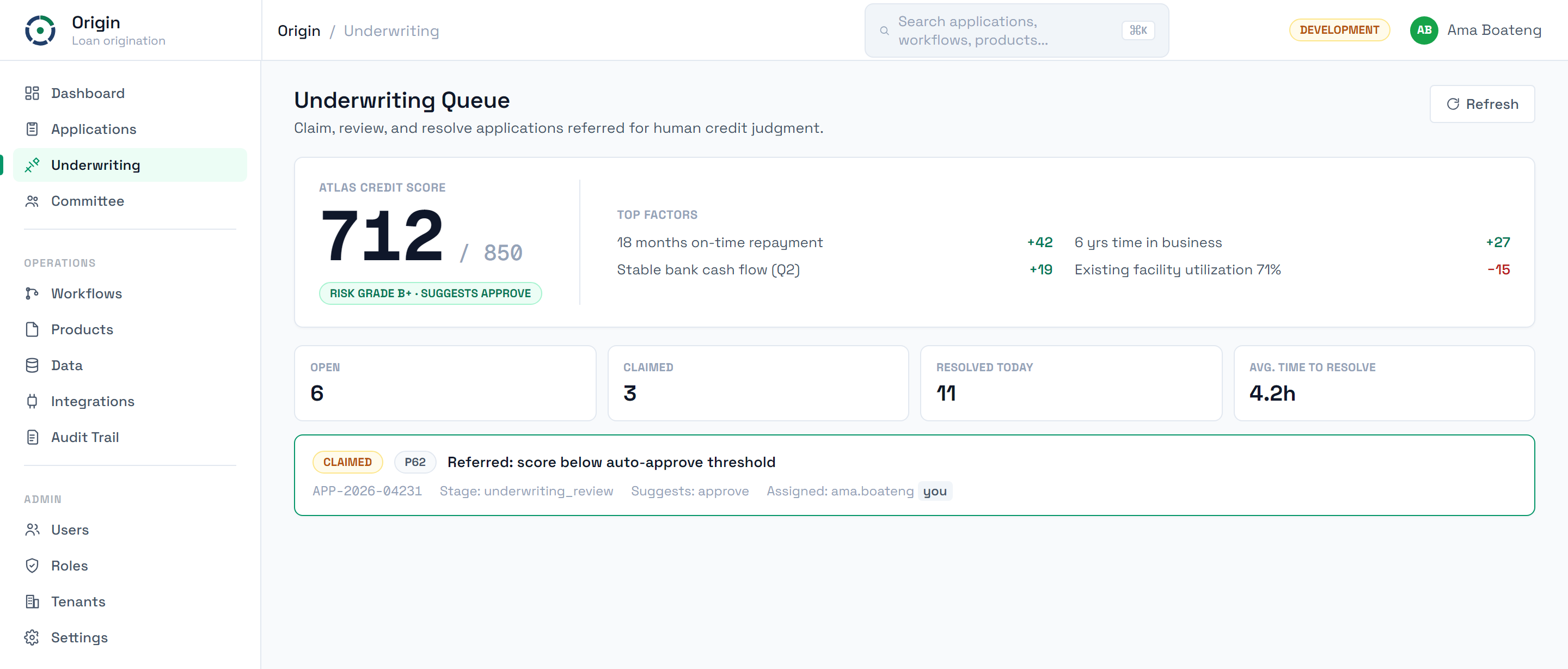
Origin runs the whole loan journey (application, scoring, fraud checks, decision, e-signing, disbursement, and collections) as one configurable, auditable workflow. It is in active development.
Explore Origin