A risk decision on every transaction, before it clears.
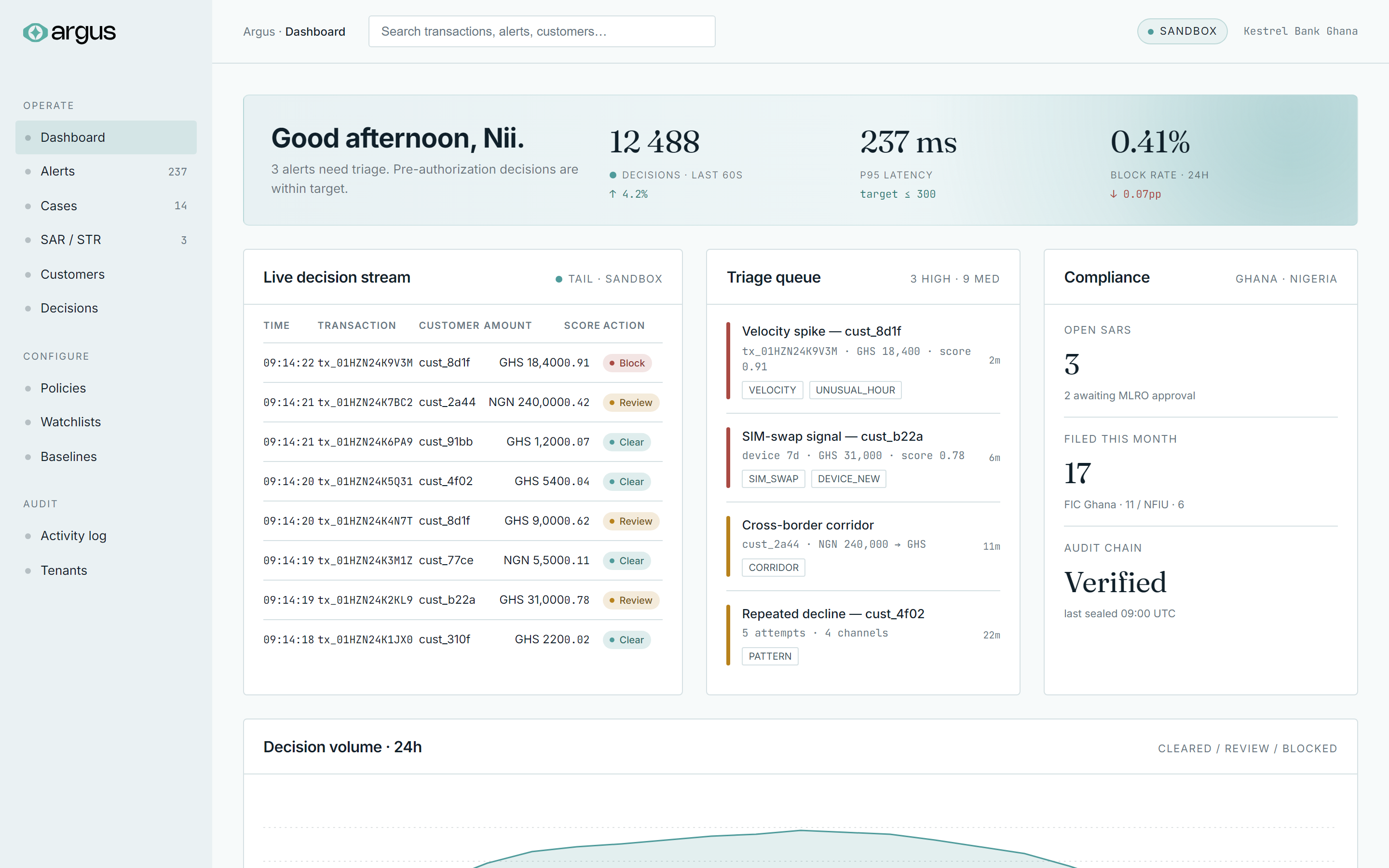
Argus runs four checks in parallel (rules, account behaviour, sanctions and watchlist screening, and an optional model) and returns one decision before the transaction clears. It explains the call in reasons an analyst can defend, drafts the SAR or STR itself, and ships tuned to the fraud typologies that Ghana and Nigeria's regulators already name.
A fraud decision has to land before the transaction clears, or it's already too late.
Rules alone catch known patterns and miss what's new; a model alone can't explain itself to an examiner. Most fraud stacks run one or the other and generate alerts an analyst never has time to work through. The fraud clears while the queue backs up.
West Africa's typologies move quickly: mobile-money account takeover, SIM-swap, structuring, dormant-account reactivation, synthetic identities; and Ghana's and Nigeria's regulators expect a filed report inside a fixed window once something looks suspicious, not a queue of unresolved alerts.
Four checks run at once, and the decision comes back in the time of the slowest one.
Every transaction runs four checks simultaneously (the institution's own rules, the account's normal behaviour, sanctions and watchlist screening, and an optional machine-learning model). A sanctions hit always blocks; the model only sharpens the score and never blocks on its own.
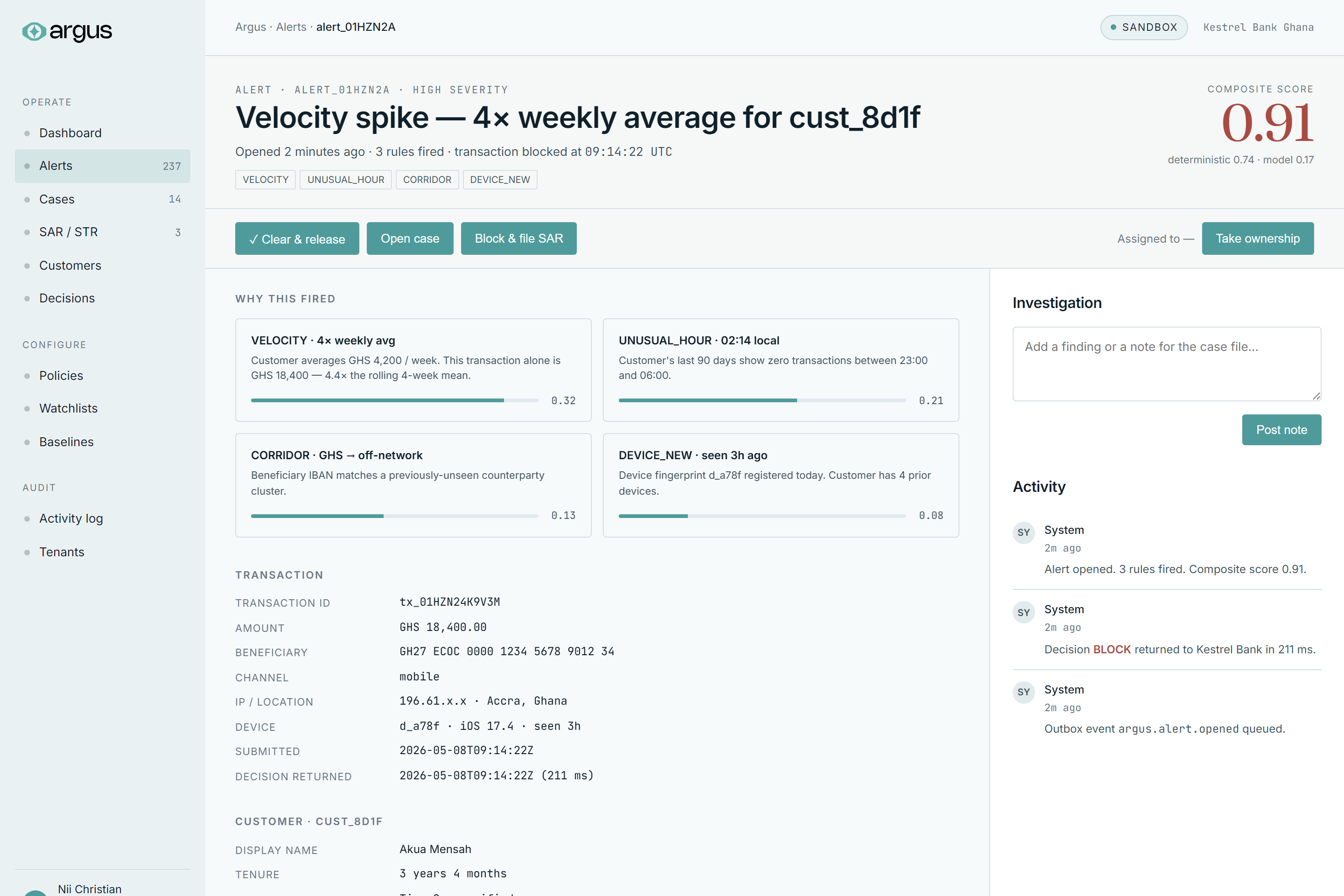
The decision returns with reason codes and the specific rule that fired, so an analyst or auditor can see why. Suspicious cases become a ready-to-file SAR or STR, formatted for Ghana's FIC and Nigeria's NFIU, for the MLRO to approve inside the 24-hour window.
A transaction lands at the API boundary and has to clear four checks before it can settle. Follow it from the decision to the filed report.
- 01 · Decide
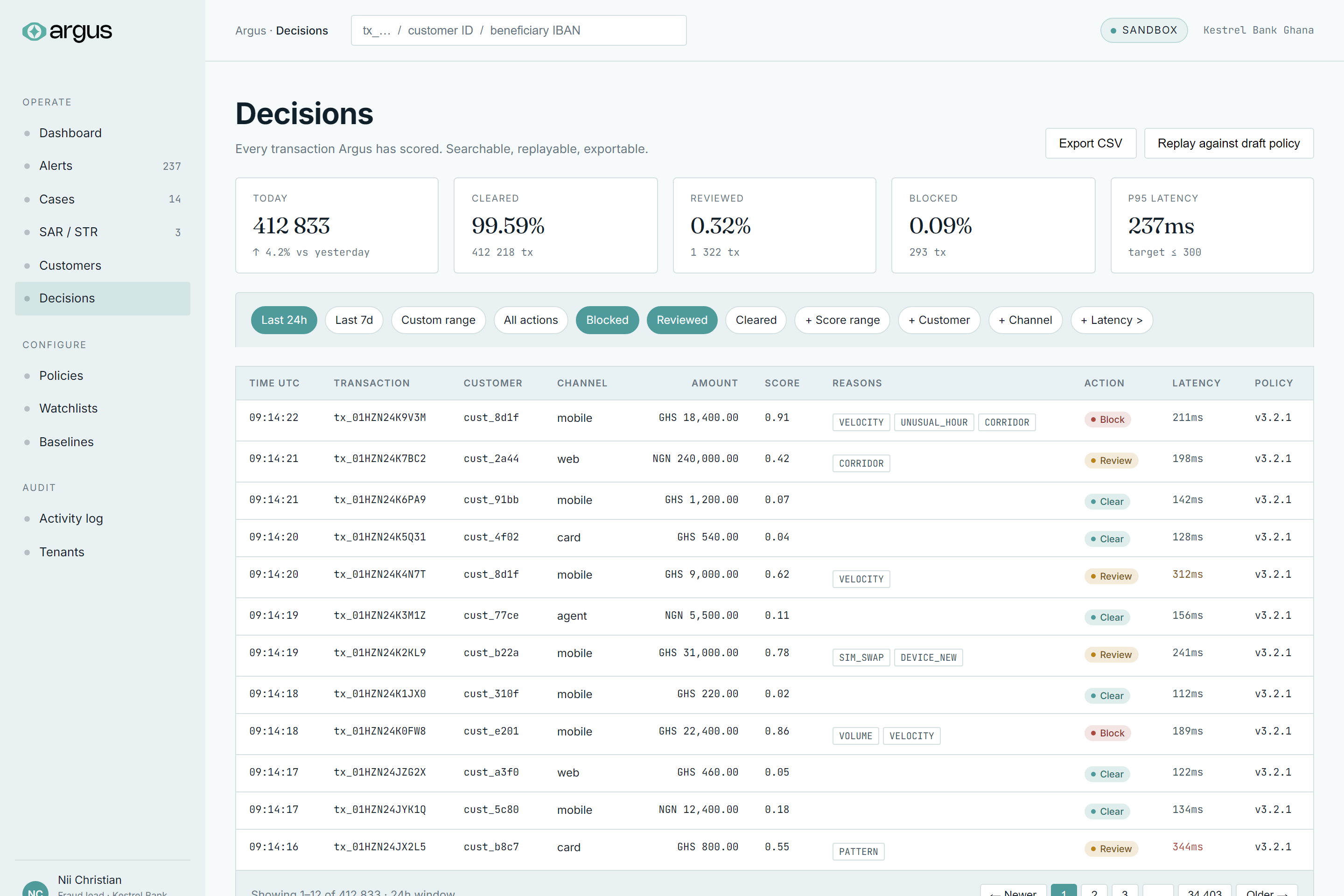
Argus decides in one pass
Four checks run in parallel (rules, behaviour, sanctions and watchlist screening, and an optional model) and combine into one action: approve, step-up, hold, block, or review. The answer comes back in the time of the slowest check, fast enough to land before the transaction clears.
- 02 · Explain
Every decision comes with its reasons
The result carries reason codes and the specific rule that fired, so an analyst reviewing the case, or an examiner reviewing the analyst, can see exactly why Argus called it that way.
- 03 · Investigate
Analysts work the case in one console
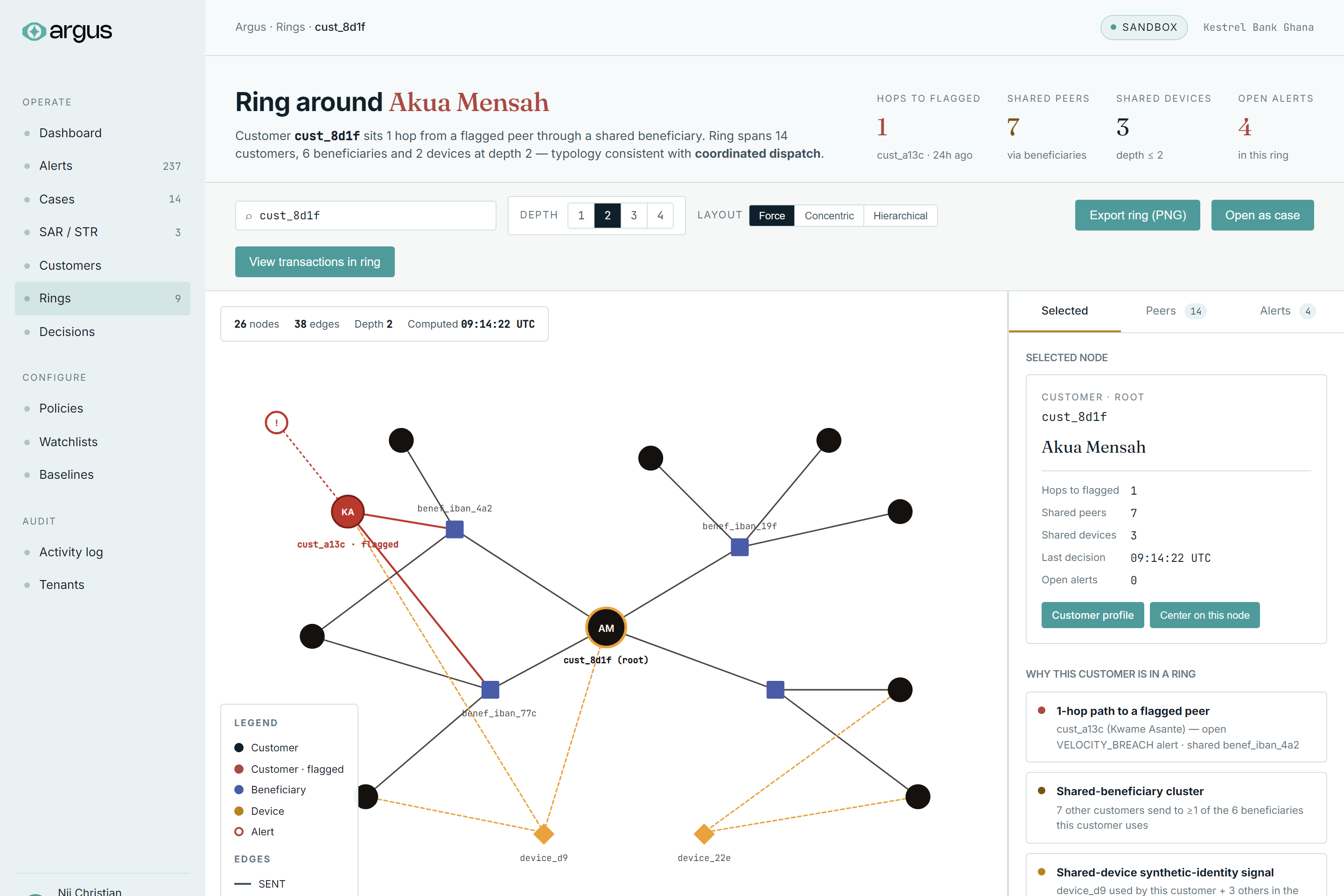
Alerts and cases move into a purpose-built console with screening, watchlists, PEP approvals, and a network view that maps how accounts connect and surfaces the money-mule rings a single-transaction check would miss.
- 04 · File
Suspicious cases file themselves
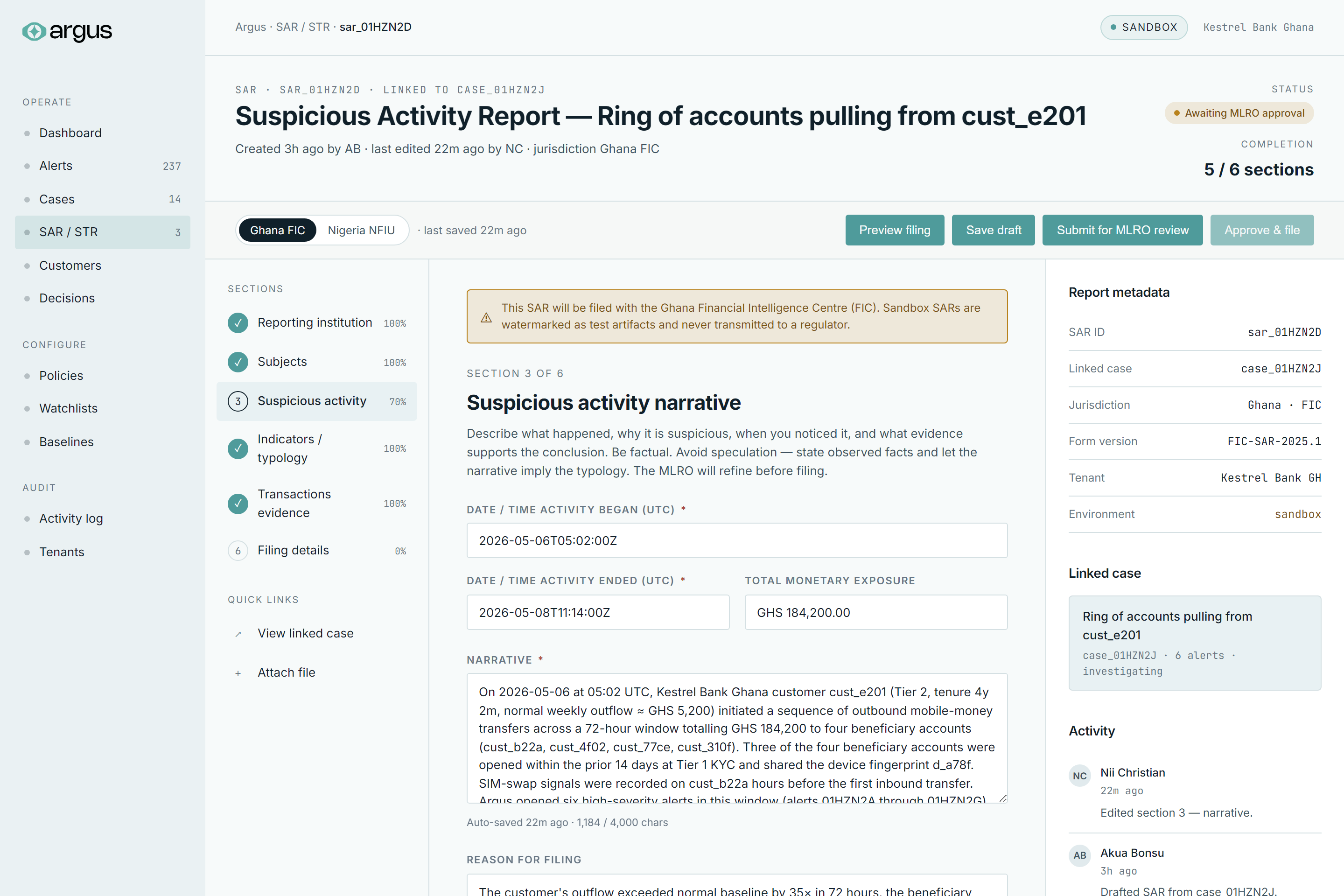
A confirmed case produces a SAR or STR formatted for Ghana's FIC or Nigeria's NFIU, ready for the MLRO to approve and file inside the 24-hour window.
The same four-check pass runs on every transaction, day and night: the difference between a clean approval and a filed report is only what the checks find.
The mule ring that would have looked like five clean transactions becomes one filed report, inside the window.
Same institution, same monitoring desk. The decision that blocked the transaction, the reasons behind it, and the report filed on the strength of them all sit on one record, defensible in an examination.
Figures are labelled by how they were established. Targets and illustrative values are not measured production results.
Built for the regulators it ships into
- Anti-Money Laundering Act 2020 (Act 1044)
- Customer due diligence and the CTR/ETCR reporting pipeline, with a senior-management approval gate for PEPs.
- BoG AML/CFT Directive (September 2025)
- Automated SAR drafting and goAML output inside the 24-hour reporting window, with Ghana's named 2024 typologies built in.
- FATF Recommendation 12 (PEP)
- A dedicated senior-management approval step for PEP-linked transactions, routed to review rather than an automatic block.
- goAML filing (GH-FIC / NG-NFIU)
- SAR/STR output formatted for both Ghana's FIC and Nigeria's NFIU, with MLRO sign-off before filing.
How it fits the platform
Verifies the platform's sign-in tokens and enforces who can see what. Argus issues none itself.
Resolves who's who across products and relays confirmed fraud signals back to the platform.
Trains the optional ML models offline; Argus keeps deciding on rules alone if a model isn't there.
Reads Argus's events for cross-product analytics and reporting, read-only.
Calls Argus during loan origination for a fast fraud and KYC decision.
Argus is built to file inside the regulatory window, every time.
The latency target holds at ≤ 300ms P95, with a benchmarked 54ms P99 at 32 workers. Typology coverage and the filing pipeline are built for Ghana's FIC and Nigeria's NFIU.
Book a technical walkthroughAtlas
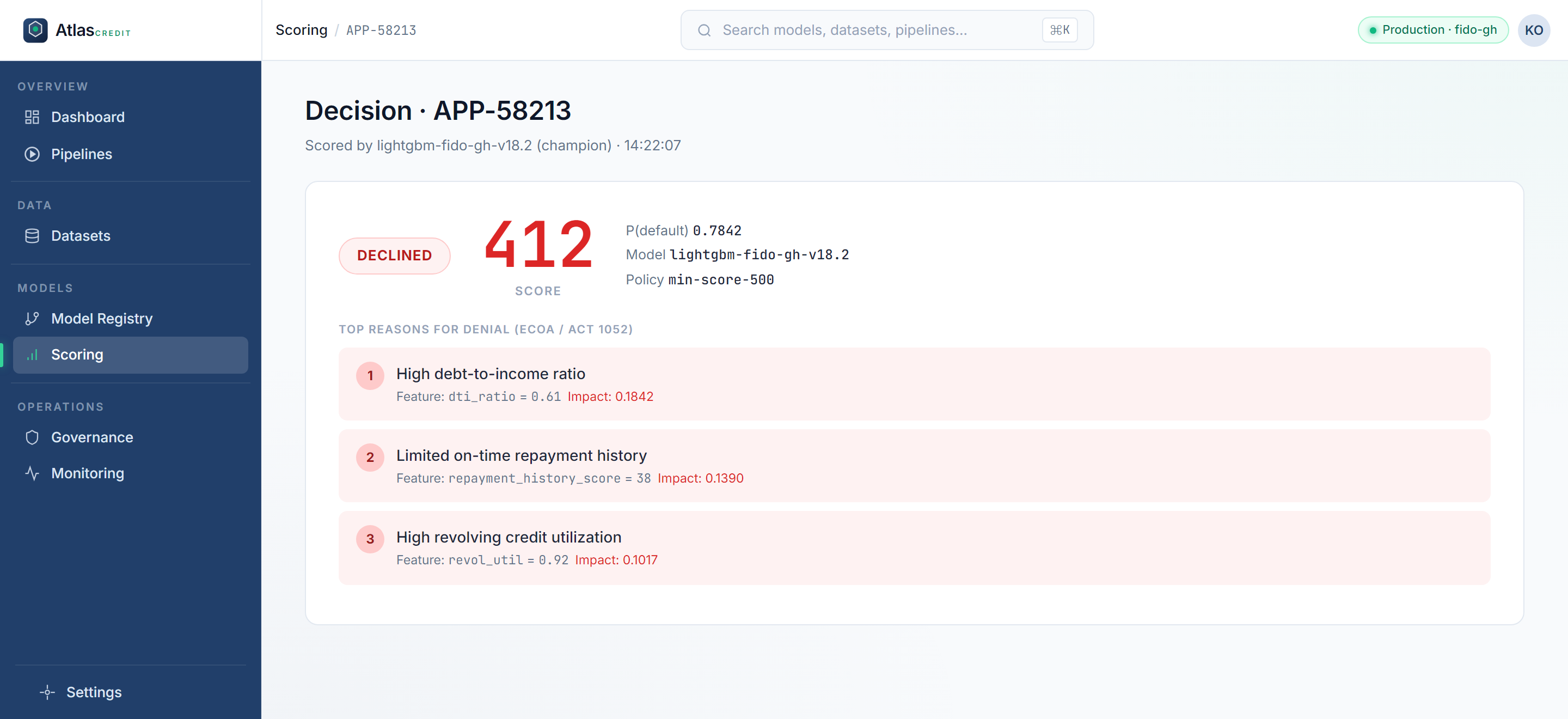
Atlas turns your own lending data into a working credit model, no data-science team needed, and every score comes with the explanation and governance a regulator expects.
Explore Atlas